Two spaces.Private graphs are yours: only you and the people you invite can read and edit them. Most are never published: they are where you think, draft a paper, plan a course or work with collaborators and agents. The public graph is curated knowledge that everyone reads; it changes through review.
Private graphs and the public graph, and the ways between them
Between them. A private graph can be attached to a public node so readers can open it from there, while it stays yours. It can be joined into the public graph as new nodes, or merged into what is already there; the owners of the nodes it changes decide (see Combining graphs).
Every new node starts a private graph. "New node" in the top bar creates a node of your own, which you can grow into a graph, or move into another of your graphs.
Who owns what decides who may change a node, in either space, and drafts keep your unsaved edits in both: both are explained below.
How it is built. Every node records which private graph it belongs to, or that it is public. Access is checked on every page and every API call, and attaching uses its own kind of link, so an attached graph never becomes part of the graph it hangs on.
Read on
Private graphs: Your own graphs: you and the people you invite read and edit them; nothing in them is public until you attach, join or merge it.
The public graph: Knowledge everyone reads: its nodes' owners edit them directly, everyone else proposes, and Root holds the top level.
Who owns what: A public node's owners are its creator and everyone whose edit to it was merged, shown by the handle they used; Root holds the top level.
Drafts: Edits you started and did not save: kept automatically while you write, so you can continue them or throw them away.
**Two spaces.** **Private graphs** are yours: only you and the people you invite can read and edit them. Most are never published: they are where you think, draft a paper, plan a course or work with collaborators and agents. **The public graph** is curated knowledge that everyone reads; it changes through review.
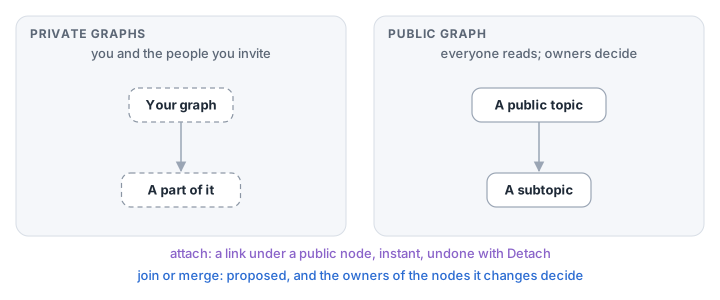
**Between them.** A private graph can be **attached** to a public node so readers can open it from there, while it stays yours. It can be **joined** into the public graph as new nodes, or **merged** into what is already there; the owners of the nodes it changes decide (see [Combining graphs](/nodes/29510)).
**Every new node starts a private graph.** "New node" in the top bar creates a node of your own, which you can grow into a graph, or move into another of your graphs.
**Who owns what** decides who may change a node, in either space, and **drafts** keep your unsaved edits in both: both are explained below.
**How it is built.** Every node records which private graph it belongs to, or that it is public. Access is checked on every page and every API call, and attaching uses its own kind of link, so an attached graph never becomes part of the graph it hangs on.
---
**Read on**
- [Private graphs](/nodes/29554): Your own graphs: you and the people you invite read and edit them; nothing in them is public until you attach, join or merge it.
- [The public graph](/nodes/29566): Knowledge everyone reads: its nodes' owners edit them directly, everyone else proposes, and Root holds the top level.
- [Who owns what](/nodes/29577): A public node's owners are its creator and everyone whose edit to it was merged, shown by the handle they used; Root holds the top level.
- [Drafts](/nodes/29543): Edits you started and did not save: kept automatically while you write, so you can continue them or throw them away.