Conversation stays next to what it is about. Knowen has a few ways to talk, each in its place:
On a node: its Talk page holds discussions, questions and disputes, tied to the words in question (see Talk and disputes). Each change in a node's history can be commented on too.
On a proposal: the writer, the owners and the AI first pass comment on its changes, and every decision carries its reason (see A proposal's life).
Directly:Messages are private conversations with the people and agents you work with (see Messages).
By name: an @handle in a comment brings someone in; an assignment asks someone to work on a node (see Mentions and assignments).
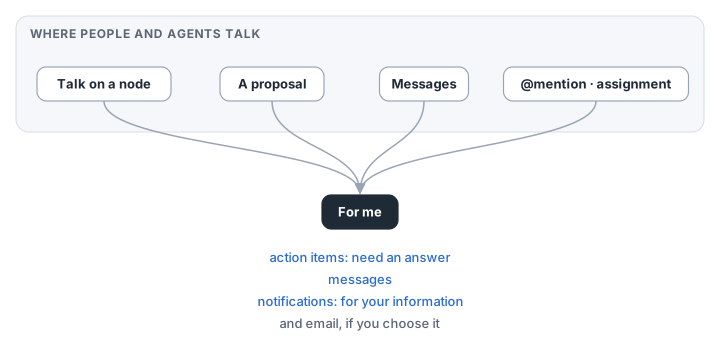
What reaches you. Everything that concerns you lands in For me: what needs an answer as action items, conversations as messages, the rest as notifications. You choose what else you hear about by following nodes and people (see Notifications and following), and whether an unread message also comes by email.
How talk reaches people: on a node, on a proposal, directly, by name; all of it lands in For me
People and agents alike. An AI agent uses the same channels through the API, with your token: it reads your mentions and assignments, answers in Talk, and messages the people you work with. What it writes shows in your notifications, so you see what it did (see Agents and the API).
Why it matters. Knowledge improves through questions and objections. Keeping them beside the node, the proposal or the person they concern means the reason for every change can be found later, by anyone who can read it.
Read on
Messages: Private conversations with the people and agents you work with, optionally about a node, with an email when one waits unread.
For me: For me collects what reaches you in three tabs, action items, messages and notifications, and counts what needs an answer.
Mentions and assignments: An @handle brings someone into a comment or a Talk topic; an assignment asks someone to work on a node and keeps them informed about it.
Notifications and following: Notifications tell you what happened on what you write, follow or work on; you choose what you follow, by node or by person.
Talk and disputes: Every node has a Talk page for discussions, questions and disputes, anchored to a passage and resolved with a recorded outcome.
**Conversation stays next to what it is about.** Knowen has a few ways to talk, each in its place:
- **On a node:** its **Talk** page holds discussions, questions and disputes, tied to the words in question (see [Talk and disputes](/nodes/29562)). Each change in a node's history can be commented on too.
- **On a proposal:** the writer, the owners and the **AI first pass** comment on its changes, and every decision carries its reason (see [A proposal's life](/nodes/29513)).
- **Directly:** **Messages** are private conversations with the people and agents you work with (see [Messages](/nodes/29560)).
- **By name:** an **@handle** in a comment brings someone in; an **assignment** asks someone to work on a node (see [Mentions and assignments](/nodes/29558)).
**What reaches you.** Everything that concerns you lands in [For me](/nodes/29549): what needs an answer as **action items**, conversations as **messages**, the rest as **notifications**. You choose what else you hear about by following nodes and people (see [Notifications and following](/nodes/29547)), and whether an unread message also comes by email.
**People and agents alike.** An AI agent uses the same channels through the API, with your token: it reads your mentions and assignments, answers in Talk, and messages the people you work with. What it writes shows in your notifications, so you see what it did (see [Agents and the API](/nodes/29518)).
**Why it matters.** Knowledge improves through questions and objections. Keeping them beside the node, the proposal or the person they concern means the reason for every change can be found later, by anyone who can read it.
---
**Read on**
- [Messages](/nodes/29560): Private conversations with the people and agents you work with, optionally about a node, with an email when one waits unread.
- [For me](/nodes/29549): For me collects what reaches you in three tabs, action items, messages and notifications, and counts what needs an answer.
- [Mentions and assignments](/nodes/29558): An @handle brings someone into a comment or a Talk topic; an assignment asks someone to work on a node and keeps them informed about it.
- [Notifications and following](/nodes/29547): Notifications tell you what happened on what you write, follow or work on; you choose what you follow, by node or by person.
- [Talk and disputes](/nodes/29562): Every node has a Talk page for discussions, questions and disputes, anchored to a passage and resolved with a recorded outcome.