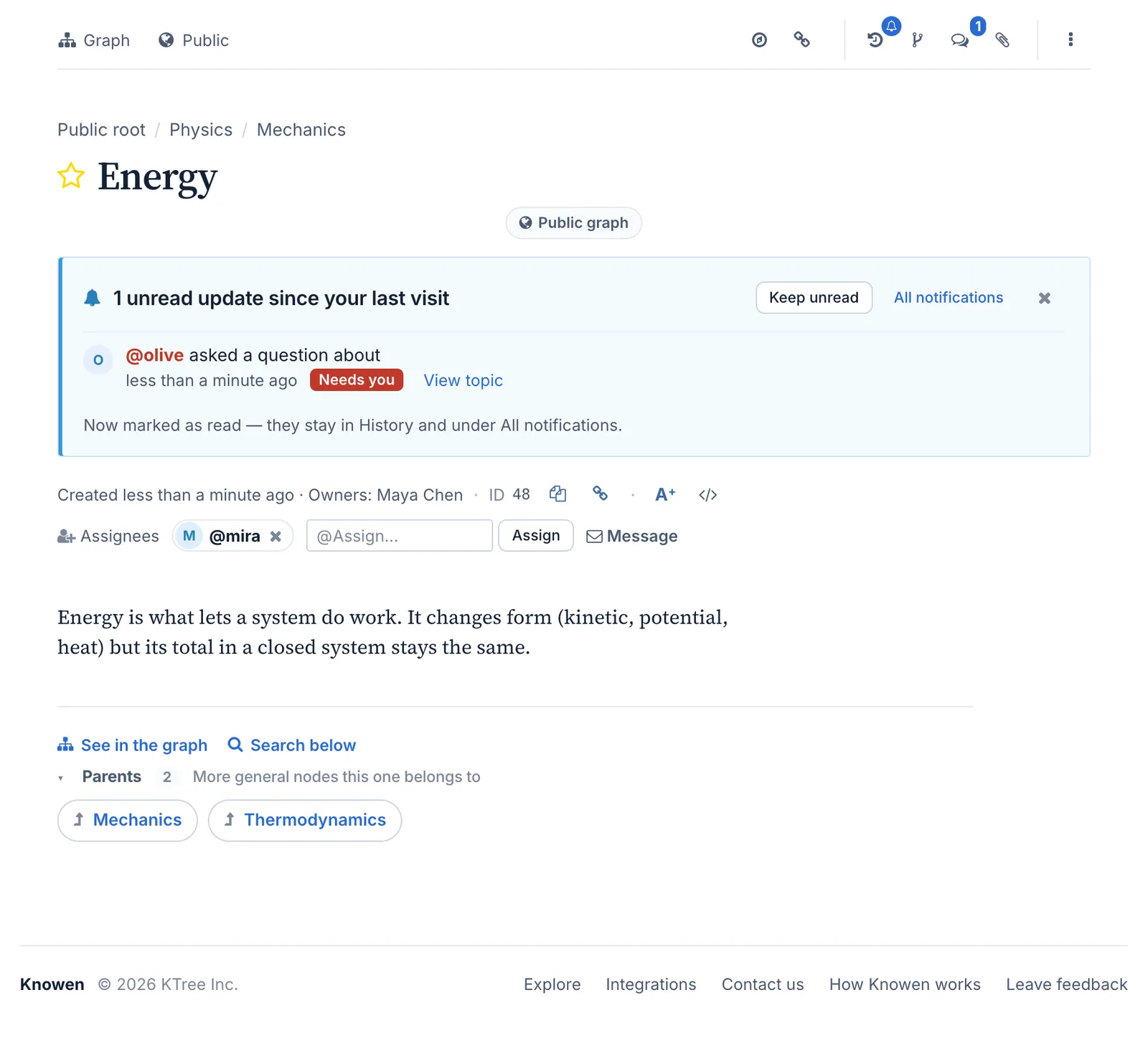
Where it sits: the path you came by, from more general nodes down to this one.
The title, with a star that adds it to your Favorites.
The meta line: when it was made and its owners, its ID (with buttons that copy the ID and a link), text size, the Markdown source, and everyone who wrote in it.
Assignees: people working on it. People who can edit a private graph, and owners of a public node, type @handle and Assign; on a public node anyone else sees Assign me (see Who can assign whom).
The text, with math, figures and references; and, for merged work, Merged from, which says where it came from.
Parents and Children: the nodes this one belongs to and the nodes that explain it further. See in the graph opens the graph view here; Search below searches this node and everything under it.
The page of Energy: its path, owners, text, and its two parents
The toolbar, above the title:
Graph (press g) and the node's space, Public or Private.
Quick navigation through the graph, and Related nodes by meaning.
History and comments: every version, comments on each change, and Receive updates for this node or everything under it.
Fork: copy it into a private graph of yours to rework it.
Talk: discussions, questions and disputes, with a count of open topics.
Files and Collaborators.
⋮ for more actions on the node, as your rights allow.
How it is built. The page is one node and its neighbours; the tools open beside it without leaving it, and moving to a parent or child swaps the page in place.
Step by step
Search under a node: Find what a branch of the graph says about something, and see the matches in the part of the graph that holds them.
**From the top.**
- **Where it sits:** the path you came by, from more general nodes down to this one.
- **The title**, with a **star** that adds it to your Favorites.
- **The meta line:** when it was made and its **owners**, its **ID** (with buttons that copy the ID and a link), text size, the Markdown source, and everyone who wrote in it.
- **Assignees:** people working on it. People who can edit a private graph, and owners of a public node, type **@handle** and **Assign**; on a public node anyone else sees **Assign me** (see [Who can assign whom](/nodes/29576)).
- **The text**, with math, figures and references; and, for merged work, **Merged from**, which says where it came from.
- **Parents** and **Children:** the nodes this one belongs to and the nodes that explain it further. **See in the graph** opens the graph view here; **Search below** searches this node and everything under it.
**The toolbar**, above the title:
- **Graph** (press **g**) and the node's space, **Public** or **Private**.
- **Quick navigation** through the graph, and **Related** nodes by meaning.
- **History and comments:** every version, comments on each change, and **Receive updates for** this node or everything under it.
- **Fork:** copy it into a private graph of yours to rework it.
- **Talk:** discussions, questions and disputes, with a count of open topics.
- **Files** and **Collaborators**.
- **⋮** for more actions on the node, as your rights allow.
**How it is built.** The page is one node and its neighbours; the tools open beside it without leaving it, and moving to a parent or child swaps the page in place.
---
**Step by step**
- [Search under a node](/nodes/29570): Find what a branch of the graph says about something, and see the matches in the part of the graph that holds them.
**Part of** [Around the screen](/nodes/29534) and [Nodes](/nodes/29537): all its parents are equal.