Two roles, held by people. Knowen is looked after by people who hold one or both administration roles:
Root decides where no one else does: at the top level of the public graph, for nodes with no owner on record, and on changes no owner has answered for a day (see Owners decide). Root also sees the whole Reviewing queue, so nothing is held up.
System management looks after accounts: plans, limits, sign-ups, confirming emails, and who holds which role.
Several people may hold each role. The Root account (@root) holds both.
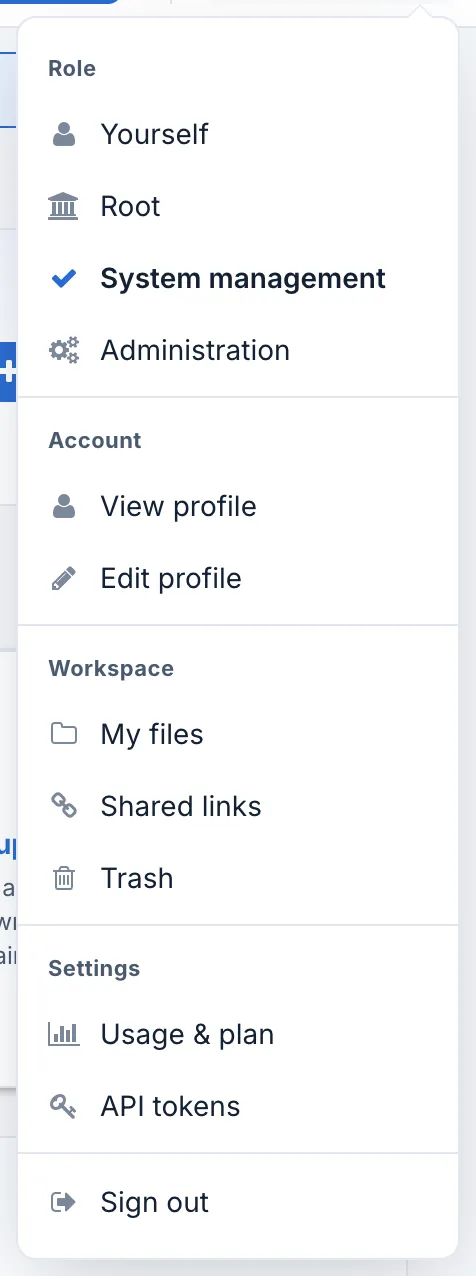
Acting in a role. Someone who holds a role switches to it from the account menu, under Role, and back to Yourself. As Root, everything they do is done by the Root account and shows as Root, never their own name or handle. A strip under the top bar says which role is on, with Switch back.
The account menu of someone who holds both roles
The Administration area, in System management, has an Account page for each person: their handles, their plan, and how much of each limit they use. From there System management can give a plan free of charge (until a date, or for good), set a limit for one account, confirm an email, and grant or revoke roles. Sign-ups, Plans and the Audit log sit beside it. How each part is built is in Running Knowen, which only role holders can open.
Everything is logged. Every change made in a role goes to an audit log under the real person's name, kept three years.
What they see. System management sees an account's email, all its handles, its plan and its usage counts, so it can help with sign-in and limits. It never sees private content: a private graph stays readable only by its members. Root reads what any member reads, plus the Reviewing queue.
How it is built. A role is a grant to a person, revoked rather than deleted. Switching to Root signs the browser session in as the Root account and remembers the person; signing out ends both. The API never switches roles. The audit log is append-only.
In development: suspending accounts and deleting them on request, two-factor sign-in for role holders, Root's content tools (hide, lock, transfer ownership), and reminders about proposals waiting 30 days.
For role holders:Running Knowen explains how all this is built. The link opens only for people who hold a role.
**Two roles, held by people.** Knowen is looked after by people who hold one or both administration roles:
- **Root** decides where no one else does: at the top level of the public graph, for nodes with no owner on record, and on changes no owner has answered for a day (see [Owners decide](/nodes/29512)). Root also sees the whole Reviewing queue, so nothing is held up.
- **System management** looks after accounts: plans, limits, sign-ups, confirming emails, and who holds which role.
Several people may hold each role. The Root account (@root) holds both.
**Acting in a role.** Someone who holds a role switches to it from the account menu, under **Role**, and back to **Yourself**. As Root, everything they do is done by the Root account and shows as **Root**, never their own name or handle. A strip under the top bar says which role is on, with **Switch back**.
**The Administration area,** in System management, has an **Account** page for each person: their handles, their plan, and how much of each limit they use. From there System management can give a plan free of charge (until a date, or for good), set a limit for one account, confirm an email, and grant or revoke roles. **Sign-ups**, **Plans** and the **Audit log** sit beside it. How each part is built is in Running Knowen, which only role holders can open.
**Everything is logged.** Every change made in a role goes to an audit log under the real person's name, kept three years.
**What they see.** System management sees an account's email, all its handles, its plan and its usage counts, so it can help with sign-in and limits. It never sees private content: a private graph stays readable only by its members. Root reads what any member reads, plus the Reviewing queue.
**How it is built.** A role is a grant to a person, revoked rather than deleted. Switching to Root signs the browser session in as the Root account and remembers the person; signing out ends both. The API never switches roles. The audit log is append-only.
**In development:** suspending accounts and deleting them on request, two-factor sign-in for role holders, Root's content tools (hide, lock, transfer ownership), and reminders about proposals waiting 30 days.
**For role holders:** [Running Knowen](/nodes/29590) explains how all this is built. The link opens only for people who hold a role.
---
**Part of** [Your account and identity](/nodes/29515) and [Who owns what](/nodes/29577): all its parents are equal.